Type Studio
Updated: Nov 11, 2023
Mentor : Rupali Gupte
This semester we studied type, pattern and material phenomenologies in Chikhali, Malusare near Mahabaleshwar, Maharashtra. Here, we looked closely at a village settlement and speculate on the various configurations of homestay facilities to promote local tourism. In order to do this we studied one village settlement closely to understand the relationships between the configurations of home and their varied relationships to inhabitation, climate and social acts.
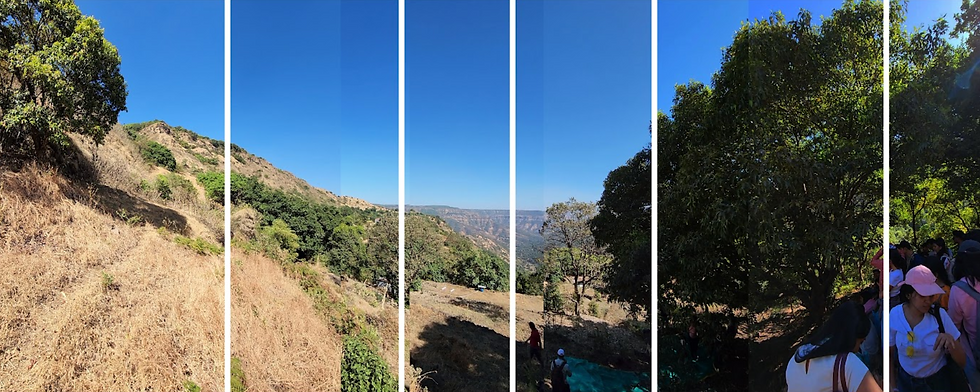
The site lies on steep slopes ; which experiences heavy rainfall from the South-west monsoon winds.
Some latent developments to the site included creating pathways up the site and clearing and filling of earth, held together by retaining walls. The hill slope is also characterized by numerous streams and waterfalls that cascade down the slopes, creating picturesque landscapes. The slopes is now adjusted with smaller retaining walls made by the local basalt rocks that provide an area of smaller flattened lands for usage and even for agriculture, with various crops on the steep slopes.
This course hinged around three ideas: building type, spatial pattern and material phenomenology.
‘Building type’ here is a generic form made of sub-components where sub-components have specific relationships with each other.
‘Spatial pattern’ here is referred to as the specific spatiality produced by each of the sub-components, where the articulation of the form of the sub-component shapes its spatiality – (eg. long, wide, squarish, tunnel-like, well-like, etc) This spatiality produces different possibilities of inhabitation.
‘Material Phenomenology’ here is referred to as the study / understanding of phenomenon, when materiality of form becomes instrumental in the experience and phenomenon of space.
Type, pattern and materiality are intrinsically linked to behaviour of the body in space. Specific space and form configurations afford particular possibilities and therefore have a distinct relationship to human behaviour.
Site Plan

Site Sections
Homestay Drawings
House 1


This house was by the entrance of the village and was divided into two parts, one for a single family each. The smaller house had a linear arrangement of spaces. The padvi was the first space by the entrance of the house, which was the most public and where the visitors were welcomed. The next space was called osri; this part of the house was the most occupied, where the inhabitants of the house spent the most of their time. Next was the ghar, the centermost part with the highest plinth level. It was a space which was only accessed by the family, where they kept their things like clothes and food. Then came the mori, which was the bathing space.The last space is thegotha, which was at the end of the house. This was where the family kept their animals. In the bigger house, an almost similar arrangement of spaces was followed, here with the padvi extending and wrapping around the house to become the kitchen space.
Patterns Identified

How change in plinth levels causes change in scale of space resulting in different levels of intimacy throughout the house.
walls and building structure used as storage spaces.
Degree of Publicness
Moment and Accessibility
Shaded and Unshaded region
Positive outdoor space
Design Intent :
From the patterns identified in the homestay drawings, the larger idea for my design was rather than treating the retaining walls existing on-site and creating spaces between them what if these retaining walls and existing foundations on-site themselves can be used to create spaces and their extensions becoming forms of inhabitation with variant volumes emerging from it. The idea was to integrate the built form into the landscape by thinking of the programmes as fragments across the site and create a mild architectural intervention.
Design Iterations
Design Plan

Sections


Cut Plans across different levels
Process Models
Model


Comments