Mass Inhabitation : Mumbai Component
Updated: Jun 5, 2025
Mentor : Prasad Shetty, Rohit Mujhondar
Introduction
The housing question has been conventionally thought through as the problem of ‘house shortage’ and this is addressed by provisioning of new houses. Here house becomes a consumable, tradable commodity and not a home. The housing produced for the poor responding to this idea of ‘housing shortage’ is of extremely poor quality with high segregation and discrimination.
A study on house-making by SEA has shown that the current habitations for the poor are built through small contractors of all kinds involving various kinds of incremental developments. This habitation is often poor due to low quality construction, planning and infrastructure that affect the dignity of life for its inhabitants. This problem cannot be solved through production of new houses (as they have themselves been poor in quality), but through organised repair and retrofitting.
The course is aimed at training students to engage with a settlement with poor habitation conditions and develop strategies of improvement which can be implemented through the cultural logics that operate. The studio focused on analysing home making practises in Thakkar Bappa Colony , a migrant settelment from Rajasthan where primary occupation is shoe making. And to project demographic conditions to speculate the next 10-15 year horizons to understand through surveys and data collected on site . This helped to make changes in house through repair and retrofit.
Site Location : Thakkar Bappa Colony , Kurla


Cluster 2 : Khorwal House
Natively from Ajmer, Rajasthan household comprises of now 5 member ; a grandmother , Household head Puranji Khorwal with his wife Sushila Devi ji with 2 sons Praveen and Tikaamchan Khorwal and a daughter married off 3 years ago now residing nearby in street no 23.
The family mainly works in the shoe making industry , particularly insole making of the shoes employed by 3rd party person working on quantity basis. Their working hours start from 8 am continuing till 11 pm with minimal break for lunch and rest in between and a single day off in 2 weeks . Both their sons are graduates but still work in the shoe making business helping their father with Praveen working as a freelance accountant part-time .
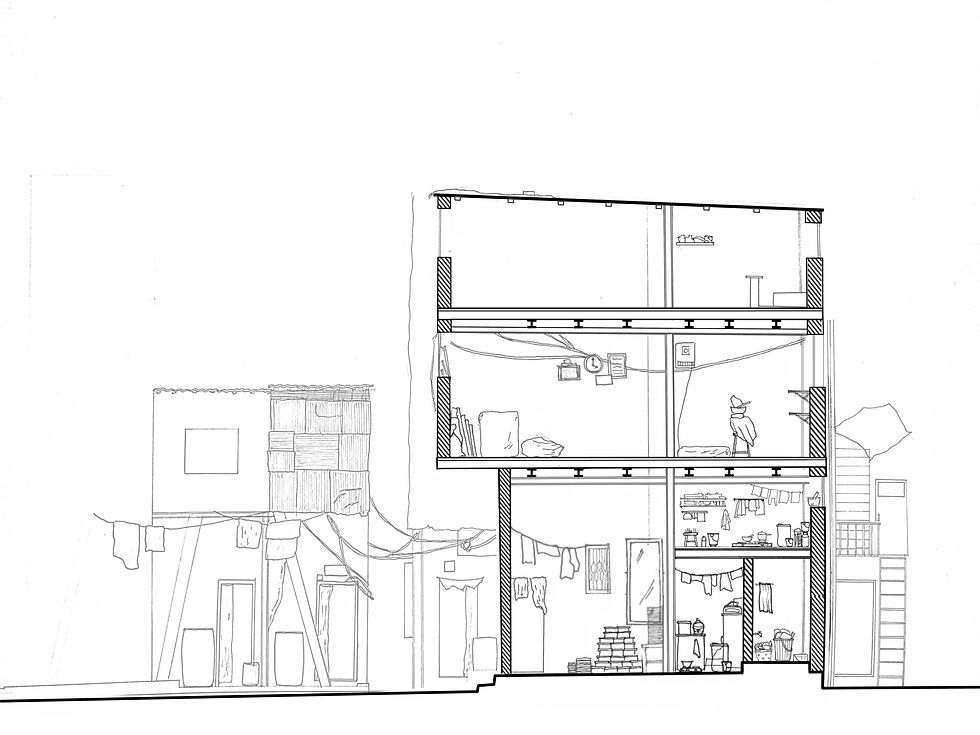
They reside in a 1.6m x 5.3m apartment , a ground plus 2 structure made from I section steel columns and GI sheet constructed 8 year ago , only using the ground floor to carry out all their functions of insole making workshop , sleeping , eating and bathing no the ground floor whereas the upper floors lie mostly dormant with some storage due to difficulty in accessing them or sometimes given on rent. Most of the houses in this cluster are linear arranged side by side, where smaller units are formed eventually and given on rent.
Cluster Plan


Sections

External Photos of the house

Internal Photos of the house

Sectional Axonometric view of the House

Evolution Of the house
The Mezzanine level was constructed 5 years after the initial building completion and the kitchen was relocated. The ground plus structure was built in 2014 by hiring a local contractor .
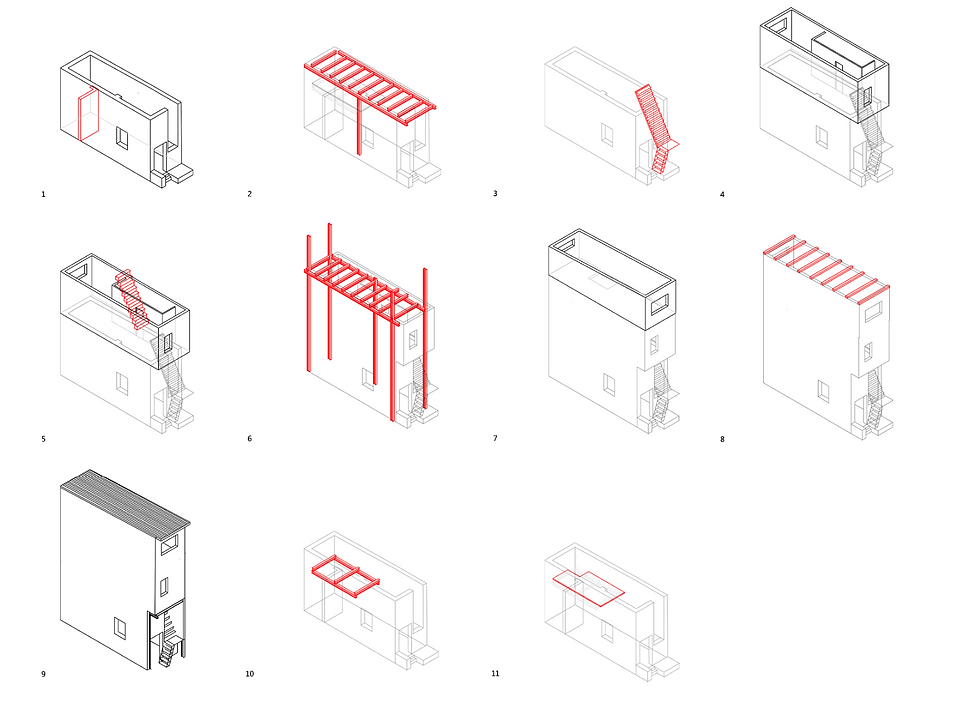

Structural System : material usage
I-shaped steel columns are as main structural l support
For the roof Gi sheet is used which sits directly onto wooden rafters
Ground floor walls are two-brick thick walls whereas the above floors are one-brick thick wall.
Flooring of all theis made by layering tile-coba-tile.

Lighting Conditions
House is a G+2 Structure with a small grill window at the back on ground which functions as an exhaust near moori , while the upper levels have windows in the front and back but barely any light enters during the built-forms adjacent and opposite blocking it.

Ventilation Analysis

The cold air barely passes through the first floor as the structure in front is lesser in height than this one. There is possibility of cold air passing in the ground floor. There is barely cross ventilation there. Tarpoline covering windows on the upper levels and opposite building being extremly close to it block ventilation.

Wetness Analysis

The degrees of wetness is shown here in this diagram. Wherein we could see more moisture near the mori and the kitchen areas. The moori on the upper floor causes leakage and dampness which percolates down to the lower floors.

Sanitation/ Services in the house


Household Members

Economic Activity

Speculations : Change in demographic and economy

Problems in Physicalities & socio-economic conditions


First Ideas


Design Plan
This design revolves around the creation of a vertically staggered floor layout, where each level serves a distinct function, creating both spatial hierarchy and functional clarity. A central staircase acts as the organizing element, seamlessly connecting the staggered levels while ensuring visual continuity and ease of movement. The staggered floor arrangement provides dynamic vertical transitions between spaces, maximizing natural light penetration and airflow, while the functional zoning creates a balance between public and private areas within the house.


Legend
Living room
Bathroom
Washroom
Staircase
Kitchen
Study room
Bedroom
Section AA'

Section BB'

End Wall Section

Roof Details

Electrical Layout

Sanitation Services


Comments