Mahim City Light Market
Updated: May 22, 2024
Mentor : Urmi Kenia , Urban Centre Mumbai
Site Location And Wider Analysis

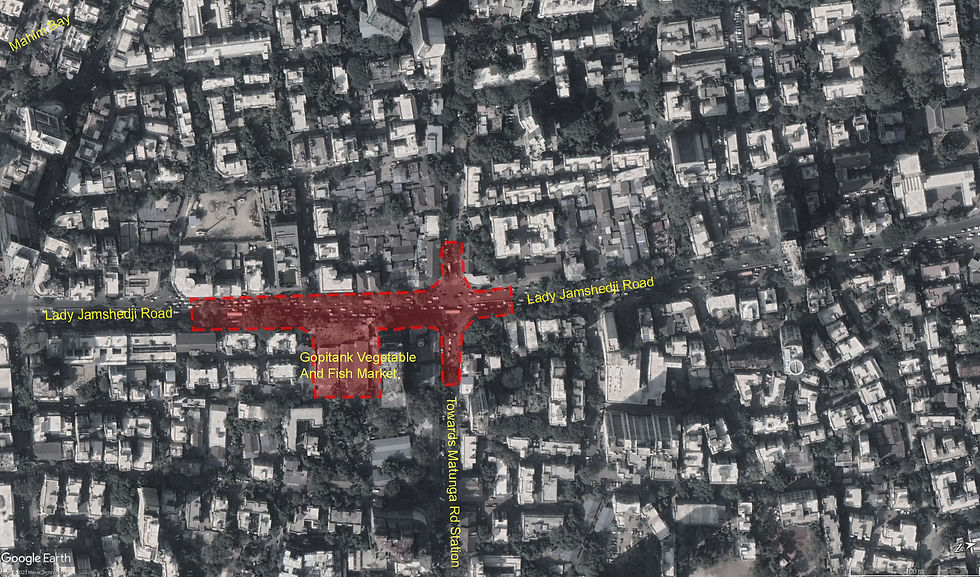
City Light Market is located near the Matunga Rd railway station on Lady Jamshedji Tata Rd which connects Dadar and Matunga leading to Mahim Bay. The area is a combination of residential areas with a large number of enterprises such as offices, shops, markets, vendors, etc. The region also caters to many eateries and food stalls around the area where people can be seen making them an important social node in the area. It holds many significant spaces of historic importance making it a major district in the city of Mumbai.
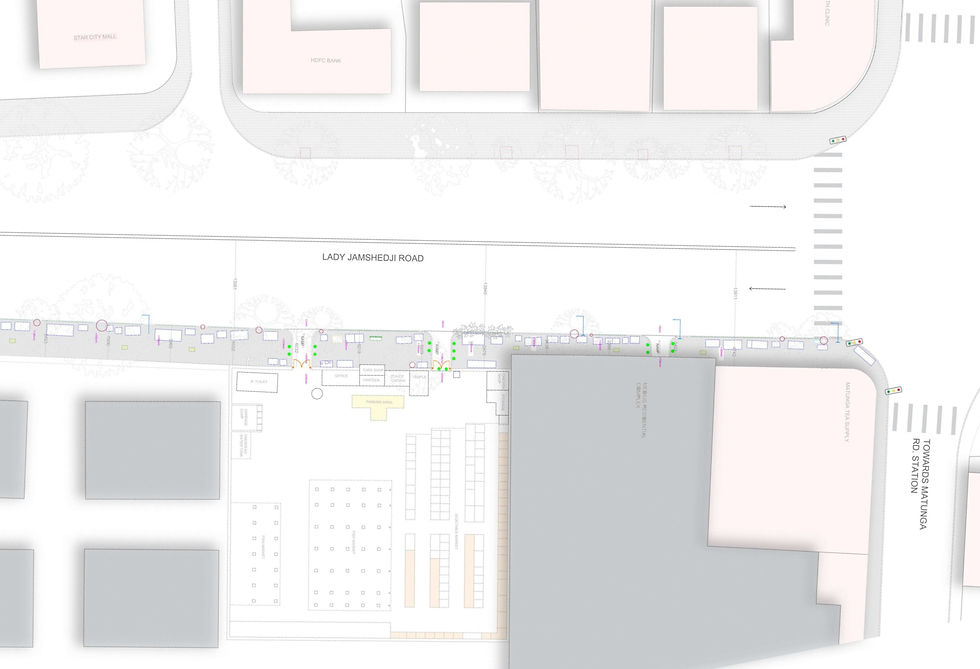
The focused site is the street on Lady Jamshedji Road along Gopitank Market. The market complex contains a major fish market and a vegetable market with some public amenities like a canteen, a public toilet etc. It has an office to ensure the smooth running of the market. The street/ footpath along the market is used by vendors to sell different types of goods such as vegetables, fruits, spices, household products, flowers, etc.
Site Overview

Delineated site
Landmarks

Site issues and Analysis
Parking on the edge of the street


Due to the scarcity of parking spaces around in the area, the vehicles are being parked on the road along and on the footpath.
Unregulated overgrowth of vegetation on Footpath


The plantations take away the free walking spaces on the footpath resulting in pedestrains spilling over on the roadway.
Kevin Lynch Survey

Development Plan Of Mahim

Issues And Observations on Site
Market Complex
Fish Market takes up two of the structures. The placement of the fish sellers is on the plinths which are surrounded by sewage systems.
Footpath
Encroachment by street vendors on footpaths reduces space for pedestrians to walk. Vendors cover the entry to the BMC market leading to accessibility problems to the market.
S.W.O.T Analysis
S(trength)
- Market Becomes a very important node of interaction for the people living in the vicinity and also the passerbuys.
W(eakness)
- Lack of parking spots for loading and unloading of goods
- overcrowding of streets due to vendor activity on both side of the street
- Improper waste management on the site leading to poor sanitation conditions
O(pourtinities)
-Creating a proper walkable footpath for the pedestrians
-Adding street furniture at certain intervals creating pause points which can also be used by the vendors to set up their stalls.
-Implementing proper waste management systems which can be used in a larger context.
T(hreats)
-Restrictions on the edge of the market since it is a public market
- Health related problems due to poor sanitation.
Activity Map

Pedestrian Movement and Vehicular Traffic

Streetscape

Site Infographics

Aim
The aim is to rethink market space and the street along it for an efficient pedestrian movement and vendors placement, and an effective garbage disposal system to manage the waste.
Objective
- To maximize visual and physical access to the market.
- To rearrange the market and street to declutter the footpath.
- To improve the footpath conditions to enhance the walking experience of pedestrians.
- To introduce a proper waste management system for better garbage disposal.
Intervention and Strategies
- Relocation of the vendors to other locations.
- Rethinking the compound wall enabling porosity
- Introducing zebra crossing/ tabletop crossing.
- Introducing Refuge Island for safe crossing zones.
- Introducing In situ panels to provide an anti-skid walking pathway.
- Introducing timed Parking in the area
- Proper signages at every node and various points.
- Implementing Only pedestrian zones after specific intervals.
- Dedicated Routes for vehicle entry and exit in the market
Site Plan
Sections

Informal Market edge screening the BMC market behind

Section across the street showing encroachment by vendors on footpath

Section highlighting the market condition
Site Intervention 1 (Minimum)


Changes proposed in minimum intervention
Organizing street vending spaces into designated vending zones.
Relocating vendors that are immediately outside the BMC market and adding street furniture.
Giving a formal entry and exit point for pedestrian and Vehicular movement.
Providing ramp access for wheel chair users and adding signages for easy way finding.
Adding a table-top speed breaker and refuge island for easier road crossing.
Removing hand railing outside the market and adding grills to the boundary wall with a pedestrian access point to promote porosity.

Changing boundary wall to a lower height with grill and adding street furniture

Relocating street vendors to both sides of the street
Visualisations
Reorganizing vendors on footpath into designated vending zones marked by white outlines.
Using In-situ Concrete for footpath material for a even and more uniform terrain resistant to skidding in rains, adding ramps for better access and preserving trees by adding tree surround.
Site Intervention 2 (Maximum)

Changes proposed in Maximum Intervention in addition to Intervention 1
Introducing retractable modular street furniture design that functions as a vending space for vendors when required as well as a sitting bench when not in use.
Formulating guidelines for vendors and introducing specific timings for vending and vehicular parking
Adding provasions for temporary parking and drop off zone for loading and unloading of goods.
Reorganizing BMC market edge for efficient functioning.
Services such as public toilets and washing area.
Establishing a proper waste management system of waste disposal
Visualizations
Reorganisation of the market complex to ensure a better waste management and circulation of vehicles.
Retractable modular street furniture that functions as a multifunctional street furniture

Design Idea for street furniture
This project is the outcome of discussions that took place in a specialisation course conducted as a vertical studio by Urban Center Mumbai in the School Of Environment And Architecture. Through site visits at the projects by UCM and case studies we looked at real world problems and the practices of the professional world. The course was divided into 5 sites throughout Mumbai. This project focuses on the Mahim City Light Market Area.


Comments